

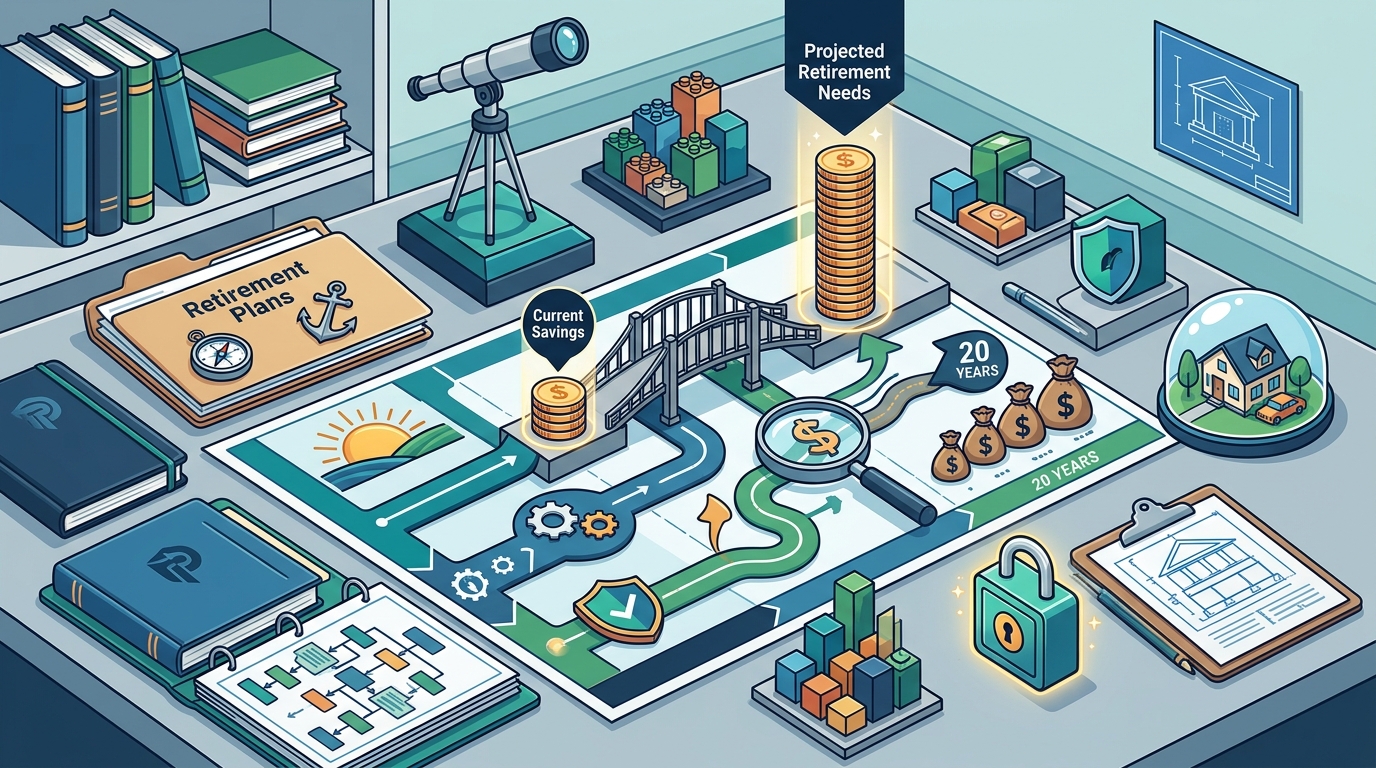
Retirement planning is no longer a linear path to a single destination. It is a dynamic ecosystem of income streams, tax strategies, and risk management protocols. According to recent industry data, the average American faces a significant gap between projected retirement needs and actual savings, with many individuals underestimating the impact of inflation on their purchasing power over a 20-year horizon. This guide outlines the precise steps to build a resilient financial foundation that aligns with your personal values and long-term goals. (Fiduciary Financial Advisors Vancouver)
Step 1: Assess Your Current Financial Health
Before constructing a future roadmap, you must understand your present position. This involves a rigorous audit of all assets, liabilities, and cash flows. Net worth calculation is the foundational metric that reveals your true financial standing. It is not merely about what you earn, but what you retain and grow over time.
Begin by listing all liquid assets, including checking accounts, savings, and investment portfolios. Next, tally your liabilities, such as mortgages, student loans, and credit card debt. The difference between these two figures is your net worth. Tracking this number annually provides a clear trajectory of your wealth accumulation. For those in the Pacific Northwest, understanding local cost-of-living adjustments is critical for accurate forecasting.
Additionally, evaluate your current debt-to-income ratio. High-interest debt can erode retirement savings faster than investment gains can build them. Prioritize paying down balances with interest rates above 6% before allocating excess capital to taxable investment accounts. This strategic shift ensures that your money works harder for you rather than being consumed by interest payments.
Step 2: Define Your Retirement Goals and Lifestyle
A comprehensive plan starts with a clear vision of what retirement looks like for you. Retirement income planning is the process of estimating the monthly cash flow required to sustain your desired lifestyle without depleting your principal. This requires moving beyond generic "replacement ratios" to personalized lifestyle modeling.
Consider the following questions to refine your goals:
- Where do you want to live? Does your current home support aging in place?
- What are your healthcare cost projections? Medicare does not cover all expenses.
- How do you want to spend your time? Travel, hobbies, and philanthropy have different cost structures.
- What is your desired retirement age? Early retirement requires a larger nest egg.
First Pacific Financial emphasizes a values-based approach to this step. We help clients align their financial decisions with their core beliefs, whether that involves charitable giving, supporting family members, or pursuing entrepreneurial ventures in retirement. This alignment ensures that your plan is not just mathematically sound, but emotionally fulfilling.
Step 3: Maximize Tax-Advantaged Contributions
Tax efficiency is a cornerstone of wealth preservation. In 2026, the IRS has introduced updated contribution limits for retirement accounts, providing new opportunities for savers to accelerate their wealth building. Understanding these changes is essential for optimizing your annual financial strategy.
401(k) and IRA Strategies
Maximizing contributions to employer-sponsored plans like a 401(k) is the first line of defense against taxes. If your employer offers a match, contribute at least enough to capture the full match, as this is an immediate 100% return on your investment. For those without access to a 401(k), a Traditional or Roth IRA offers significant tax benefits.
The choice between Traditional and Roth accounts depends on your current versus expected future tax bracket. If you anticipate being in a higher tax bracket during retirement, a Roth account may be more advantageous because qualified withdrawals are tax-free. Conversely, if you expect a lower tax bracket, a Traditional account provides immediate tax deductions that can be reinvested.
Health Savings Accounts (HSAs)
Often overlooked, Health Savings Accounts (HSAs) offer a triple tax advantage: contributions are tax-deductible, growth is tax-free, and withdrawals for qualified medical expenses are tax-free. After age 65, you can withdraw funds for non-medical expenses without penalty, effectively making it a supplemental retirement account.
Step 4: Structure Your Investment Allocation
Your investment strategy must evolve as you approach retirement. Investment management is not just about picking stocks; it is about constructing a portfolio that balances growth potential with capital preservation. This is often referred to as asset allocation.
Asset Allocation by Age
| Age Group | Recommended Equity Allocation | Recommended Fixed Income Allocation | Primary Goal |
|---|---|---|---|
| 20-35 | 80-90% | 10-20% | Long-term Growth |
| 36-50 | 60-70% | 30-40% | Balanced Growth |
| 51-65 | 40-50% | 50-60% | Income Generation |
| 65+ | 20-30% | 70-80% | Capital Preservation |
This table provides a general framework, but individual circumstances vary. Factors such as risk tolerance, health status, and other sources of income (such as Social Security or pensions) must be considered. A diversified portfolio across domestic and international markets helps mitigate the risk of any single economic downturn impacting your entire wealth.
First Pacific Financial utilizes a holistic approach to investment management, integrating socially responsible investing options for clients who wish to align their portfolios with their ethical values. This ensures that your money supports companies that reflect your commitment to positive change.
Step 5: Implement Risk Management and Insurance
Retirement plans are vulnerable to unexpected events. Risk management involves identifying potential threats to your financial security and implementing strategies to mitigate them. This includes life insurance, disability insurance, and long-term care insurance.
Long-Term Care Insurance
One of the most significant risks in retirement is the cost of long-term care. Medicare does not cover custodial care, which can cost tens of thousands of dollars per year. Long-term care insurance can protect your assets from being depleted by healthcare expenses. The earlier you purchase this coverage, the lower the premiums will be.
Disability Insurance
Disability is a more common risk than many realize. If you are unable to work due to injury or illness, disability insurance replaces a portion of your income. This is particularly important for those who are still accumulating wealth and have not yet reached their retirement savings goals.
Step 6: Finalize Estate and Legacy Planning
A comprehensive retirement plan extends beyond your lifetime. Estate planning ensures that your assets are distributed according to your wishes and that your loved ones are protected from unnecessary taxes and legal complications.
Key Estate Planning Documents
- Will: Outlines how your assets will be distributed and who will manage your estate.
- Trust: Can help avoid probate, maintain privacy, and provide for beneficiaries with special needs.
- Power of Attorney: Designates someone to make financial decisions if you are incapacitated.
- Healthcare Directive: Specifies your medical treatment preferences and designates a healthcare proxy.
Charitable giving strategies can also play a role in your estate plan. Donor-advised funds and charitable remainder trusts can provide tax benefits while supporting causes you care about. First Pacific Financial helps clients explore these options to create a lasting legacy that reflects their values.
Key Takeaways
- Start Early: The power of compound interest makes early contributions critical to long-term wealth accumulation.
- Maximize Tax Advantages: Utilize 401(k)s, IRAs, and HSAs to reduce your taxable income and grow wealth tax-free.
- Diversify Investments: A balanced portfolio across asset classes helps manage risk and stabilize returns.
- Plan for Healthcare: Account for long-term care costs and secure appropriate insurance coverage.
- Update Your Estate Plan: Regularly review and update your will, trust, and powers of attorney.
- Align with Values: Ensure your financial plan supports your personal goals and charitable interests.
- Seek Professional Guidance: A fiduciary advisor can provide personalized advice tailored to your unique situation.
Frequently Asked Questions
What is the first step in creating a retirement plan?
The first step is to assess your current financial health by calculating your net worth and understanding your cash flow. This provides the baseline for all future planning.
How much money do I need to retire?
There is no one-size-fits-all answer. It depends on your desired lifestyle, healthcare needs, and longevity. A common rule of thumb is to aim for 70-80% of your pre-retirement income, but this should be customized to your specific goals.
When should I start taking Social Security benefits?
You can start as early as age 62, but your benefits increase for each year you delay up to age 70. The optimal time depends on your health, other income sources, and tax situation.
What is the difference between a Traditional and Roth IRA?
Traditional IRA contributions are tax-deductible, but withdrawals are taxed. Roth IRA contributions are made with after-tax dollars, but qualified withdrawals are tax-free. The best choice depends on your current and expected future tax brackets.
How can I protect my retirement savings from market volatility?
Diversification is key. By spreading your investments across different asset classes, such as stocks, bonds, and real estate, you can reduce the impact of any single market downturn on your overall portfolio.
What is a fiduciary financial advisor?
A fiduciary is legally obligated to act in your best interest. This means they must put your needs ahead of their own, ensuring that their advice is unbiased and transparent.
How often should I review my retirement plan?
You should review your plan at least annually or after any major life event, such as marriage, divorce, birth of a child, or job change. Regular reviews ensure your plan stays on track.
Schedule Your Financial Review
Creating a comprehensive retirement plan is a complex process that requires expertise, discipline, and ongoing adjustment. First Pacific Financial is dedicated to helping you navigate this journey with confidence. Our team of fiduciary advisors in Vancouver, WA, and beyond, is here to provide the guidance you need to achieve your financial goals.
We invite you to schedule a consultation to discuss your unique situation. Whether you are just starting to save or are nearing retirement, we can help you build a plan that empowers you to live the life you envision. Visit our services page to learn more about our wealth management offerings.