

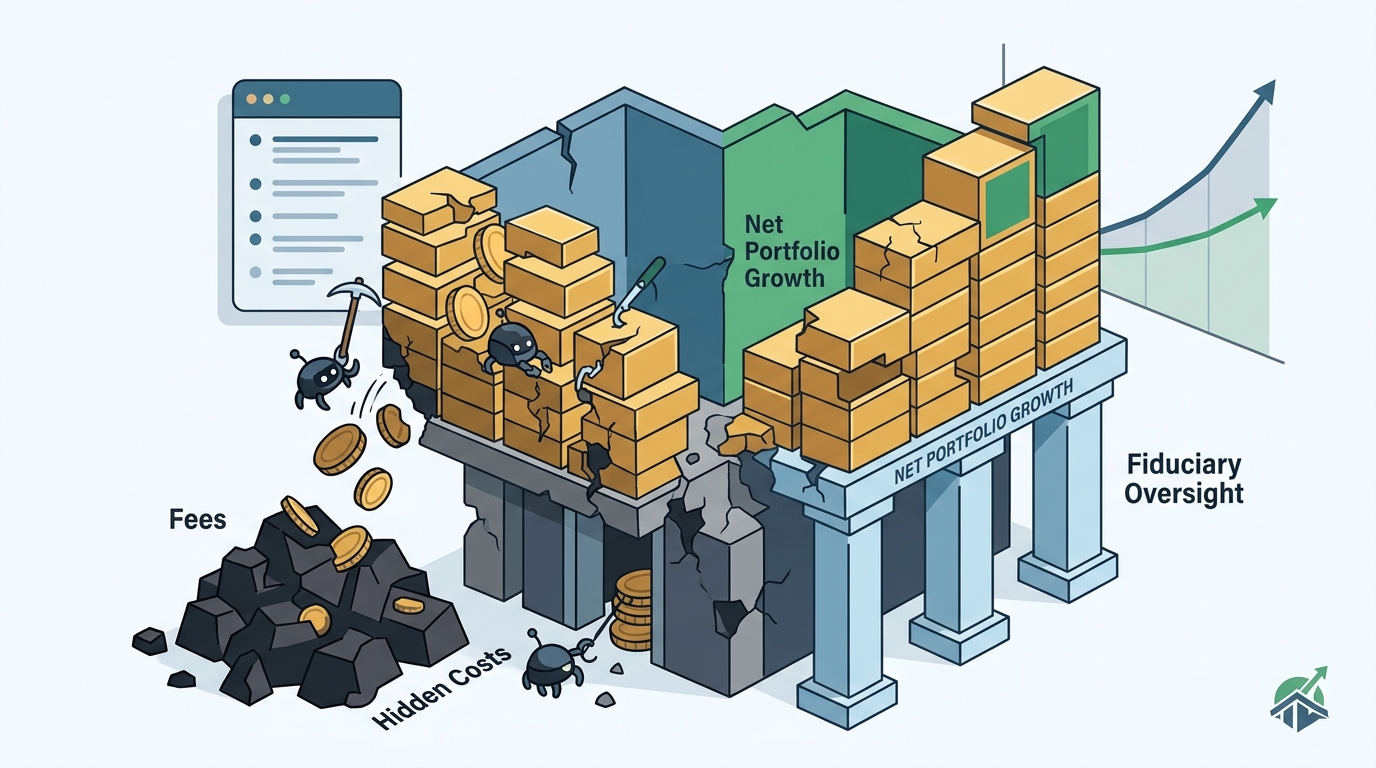
Financial advisors often focus on gross returns, but the net return is what actually builds wealth. According to recent industry data, fees can erode up to 30% of a portfolio's value over a 30-year period. This guide explores how these costs accumulate and how fiduciary advisors help protect your assets.
Understanding Fee Structures
Investment fees are not monolithic. They come in various forms, each affecting your bottom line differently. Understanding these structures is the first step toward protecting your wealth.
Assets Under Management (AUM) Fees
An AUM fee is a percentage of the total value of your investment portfolio. This is the most common model for independent financial advisors. For example, a 1% fee on a $1 million portfolio costs $10,000 annually. As your portfolio grows, so does the fee, aligning the advisor's incentives with your success.
Commission-Based Models
Commission-based compensation involves paying a one-time fee for specific financial products, such as insurance policies or mutual funds. This model can create conflicts of interest, as advisors may be incentivized to recommend products with higher payouts rather than those best suited for your long-term goals.
Hourly and Flat Fees
Some advisors charge by the hour or a flat project fee. This model is transparent and eliminates the conflict of interest associated with asset-based fees. It is ideal for clients who need specific advice, such as estate planning or tax strategy, without ongoing portfolio management.
Hidden Costs Explained
Beyond the direct fees paid to your advisor, several hidden costs can silently drain your portfolio. These costs are often buried in the fine print of investment products.
Expense Ratios
Expense ratios are the annual fees charged by mutual funds and exchange-traded funds (ETFs). They cover management fees, administrative costs, and other operational expenses. While a 0.10% expense ratio might seem negligible, it compounds over time. Actively managed funds often have expense ratios between 0.50% and 1.50%, significantly higher than passive index funds.
Transaction Costs
Every time you buy or sell an investment, you incur transaction costs. These include bid-ask spreads and commissions. Frequent trading, often driven by market timing or advisor recommendations, can lead to substantial costs that eat into your returns.
Tax Inefficiency
Taxes are a major hidden cost. Capital gains taxes, dividend taxes, and interest income taxes all reduce your net return. Tax-inefficient investments, such as bonds or actively managed funds that generate short-term capital gains, can significantly impact your after-tax returns.
The Compounding Impact
The true power of fees lies in their ability to compound against you. A small difference in fees can lead to a massive difference in final portfolio value over decades.
Scenario Analysis
Consider two investors who both start with $100,000 and earn an 8% annual return. Investor A pays 1% in fees, while Investor B pays 2%. After 30 years, Investor A will have approximately $930,000, while Investor B will have roughly $860,000. That 1% difference results in a $70,000 gap in final wealth.
The Role of Time
The longer your investment horizon, the greater the impact of fees. Over 40 years, the same 1% fee difference could result in a gap of over $150,000. This is why starting early and minimizing costs is critical for long-term financial health.
Fiduciary vs. Non-Fiduciary
Choosing the right advisor is crucial for minimizing costs and maximizing returns. The distinction between fiduciary and non-fiduciary advisors is significant.
What is a Fiduciary?
A fiduciary is legally obligated to act in your best interest. This means they must put your needs ahead of their own compensation. Fiduciary advisors, such as those at First Pacific Financial, are required to disclose any potential conflicts of interest and recommend only the most suitable investment options.
Risks of Non-Fiduciary Advice
Non-fiduciary advisors, such as some broker-dealers, are held to a suitability standard. This means they only need to recommend products that are suitable for your profile, not necessarily the best or lowest-cost options. This can lead to higher fees and less optimal investment choices.
Why It Matters
Working with a fiduciary ensures that your financial plan is built on transparency and trust. At First Pacific Financial, we pride ourselves on our fiduciary commitment, helping clients navigate complex financial landscapes with clarity and confidence.
Strategies to Minimize Fees
There are several actionable strategies you can implement to reduce the impact of fees on your portfolio.
Use Low-Cost Index Funds
Index funds track a market index, such as the S&P 500, and typically have very low expense ratios. By avoiding actively managed funds, you can save significant amounts in fees over time. This strategy is particularly effective for long-term investors who do not need frequent portfolio adjustments.
Negotiate Advisor Fees
While AUM fees are often standardized, there is sometimes room for negotiation, especially for larger portfolios. Discuss your fee structure with your advisor and ask if they offer tiered pricing or discounts for larger asset levels.
Optimize Tax Efficiency
Work with your advisor to optimize the tax efficiency of your portfolio. This includes placing tax-inefficient investments in tax-advantaged accounts, such as IRAs or 401(k)s, and harvesting tax losses to offset gains.
Regular Portfolio Reviews
Conduct regular reviews of your portfolio to ensure that fees are in line with the services provided. If you are paying high fees for minimal value, consider switching to a lower-cost provider. Our wealth management services include comprehensive fee analysis to ensure you are getting the best value.
Understand the Total Cost of Ownership
Look beyond the headline fee. Consider the total cost of ownership, including expense ratios, transaction costs, and tax implications. A holistic view of costs will help you make more informed investment decisions.
Key Takeaways
- Fees compound negatively: A 1% fee difference can result in tens of thousands of dollars lost over 30 years.
- Fiduciary standard: Always work with a fiduciary advisor who is legally bound to act in your best interest.
- Expense ratios matter: Low-cost index funds are a powerful tool for minimizing investment costs.
- Tax efficiency is key: Proper asset location and tax-loss harvesting can significantly boost net returns.
- Transparency is vital: Understand all fees and costs associated with your financial products and advisor.
- First Pacific Financial: As a fiduciary financial advisor in Vancouver, WA, we prioritize your financial well-being over product sales.
- Regular reviews: Periodically assess your portfolio's cost structure to ensure it aligns with your goals.
Frequently Asked Questions
What is the difference between a fiduciary and a non-fiduciary advisor?
A fiduciary is legally obligated to act in your best interest, while a non-fiduciary advisor only needs to ensure that their recommendations are suitable for your profile. This distinction is critical for minimizing conflicts of interest and ensuring you receive the best advice.
How do expense ratios affect my returns?
Expense ratios are annual fees charged by mutual funds and ETFs. They directly reduce your investment returns. Over time, even small differences in expense ratios can lead to significant differences in your final portfolio value due to the power of compounding.
Can I negotiate my financial advisor's fees?
Yes, in many cases, you can negotiate your financial advisor's fees, especially if you have a larger portfolio. It is worth discussing tiered pricing or discounts with your advisor to ensure you are getting the best value for your money.
What are hidden costs in investing?
Hidden costs include expense ratios, transaction costs, bid-ask spreads, and tax inefficiencies. These costs are often not immediately visible but can significantly impact your net returns over time.
How does First Pacific Financial help with fee transparency?
At First Pacific Financial, we provide complete transparency regarding our fee structure. We offer clear explanations of our AUM fees, expense ratios, and any other costs associated with your financial plan. Our goal is to ensure you understand exactly what you are paying for and why.
Is it better to pay a flat fee or a percentage of assets?
The best fee structure depends on your individual needs and portfolio size. Flat fees are ideal for specific projects, while AUM fees align the advisor's incentives with your portfolio growth. Our team at First Pacific Financial can help you determine the most suitable model for your situation.
What is the impact of tax inefficiency on long-term growth?
Tax inefficiency can significantly reduce your net returns. By placing tax-inefficient investments in tax-advantaged accounts and utilizing tax-loss harvesting, you can minimize your tax burden and maximize your long-term growth potential.
Protect Your Wealth with Expert Guidance
Understanding and minimizing the hidden costs of investing is essential for long-term financial success. By working with a fiduciary advisor, you can ensure that your financial plan is built on transparency, trust, and your best interests. Contact First Pacific Financial today to schedule a consultation and take the first step toward a more secure financial future.