

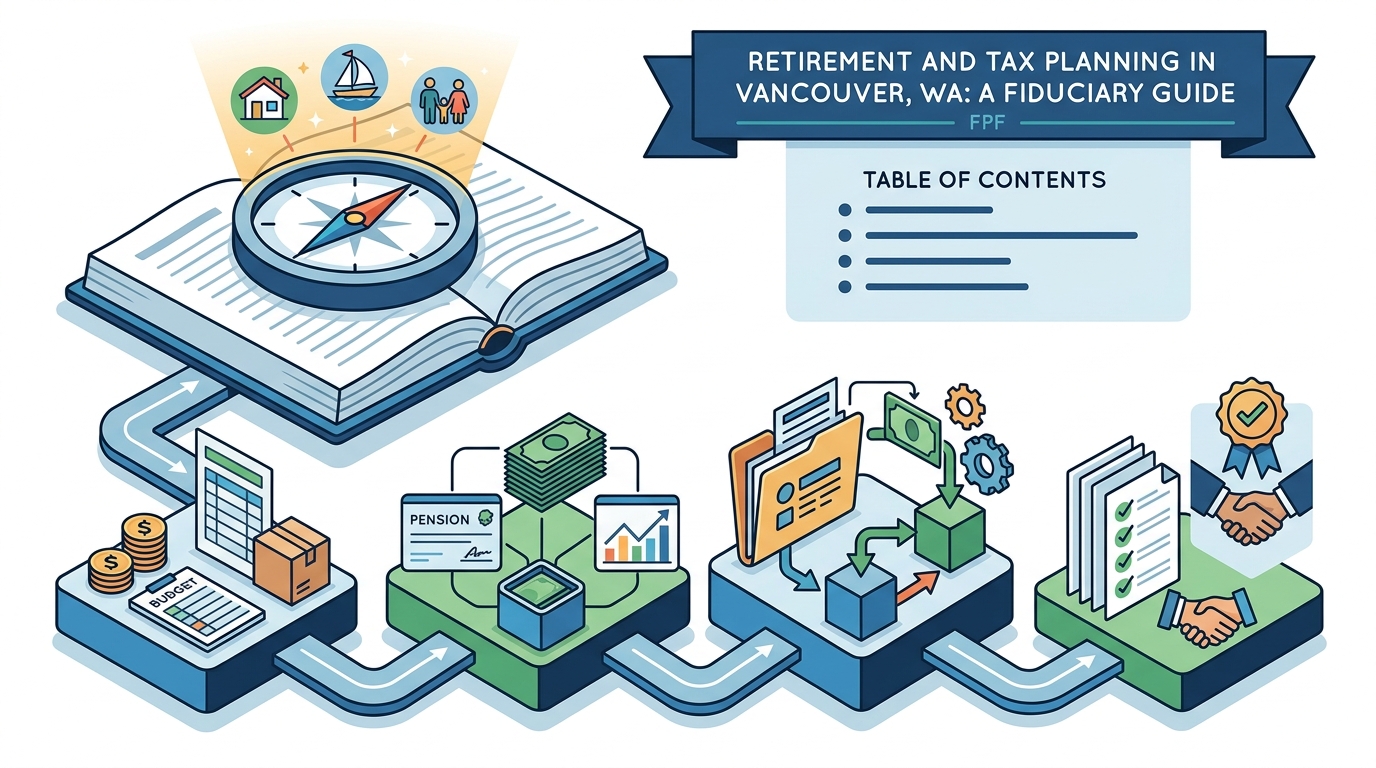
First Pacific Financial is a fee-only, fiduciary CFP® advisory firm in Vancouver, WA, that helps individuals and families integrate tax strategy with retirement planning. This guide covers how to estimate spending, manage income sources, optimize tax-advantaged accounts, and select a fiduciary advisor. It provides a structured framework for aligning your financial decisions with your long-term values and goals.
Retirement Spending Estimation
Accurate spending estimation is the foundation of any viable retirement plan. Retirement spending estimation is the process of projecting future expenses to ensure your assets last throughout your retirement. Most individuals experience a shift in spending patterns once they stop working. Discretionary costs related to commuting, professional wardrobe, and work-related travel typically decrease. However, healthcare and leisure expenses often increase. A robust plan accounts for these shifts rather than relying on a single static number. For additional details, review the .
Fixed vs. Variable Costs
Inflation and Longevity
Inflation erodes purchasing power over time. A dollar today will not buy the same amount of goods in twenty years. Longevity risk is the risk of outliving your savings. Modern life expectancy has increased significantly, meaning many retirees will spend three decades or more in retirement. Planning for a longer horizon requires a dynamic approach to spending. It is not enough to have a fixed amount; the amount must grow to keep pace with inflation. For additional details, review the Customer Experience.
Income Sources
Guaranteed Income
Guaranteed income provides a safety net. Social Security and pensions are primary examples. These sources are predictable and often tax-advantaged. Establishing a baseline of guaranteed income allows you to cover essential living expenses. This reduces the pressure to withdraw from investment accounts during market downturns. It provides psychological comfort and financial stability. For additional details, review the Frequently Asked Questions.
Investment Income
Tax-Advantaged Accounts
Traditional vs. Roth
Employer Plans
401(k) and 403(b) plans often come with employer matching contributions. This is free money that boosts your savings. Maximizing contributions up to the match is a priority. These plans also have higher contribution limits than IRAs. They are a critical component of most retirement strategies. Integrating employer plans with individual IRAs creates a comprehensive tax-advantaged portfolio. For additional details, review the About.
Asset Allocation
Asset allocation determines the risk and return profile of your portfolio. Asset allocation is the distribution of investments across different asset classes such as stocks, bonds, and cash. It is the single most important factor in determining long-term portfolio performance. A well-diversified portfolio balances growth potential with capital preservation. The optimal allocation changes as you approach and enter retirement.
Stocks and Bonds
Rebalancing
Rebalancing is the process of adjusting your portfolio back to its target allocation. Over time, market movements will cause your allocation to drift. Rebalancing forces you to sell high and buy low. It maintains your intended risk level. Regular rebalancing, whether annual or based on thresholds, is a disciplined approach to managing risk. It prevents emotional decision-making during market turbulence.
Withdrawal Strategy
How you withdraw money is as important as how you save it. A withdrawal strategy is a systematic plan for drawing down retirement assets to fund living expenses. The goal is to sustain withdrawals for the duration of your life. Poor withdrawal strategies can lead to running out of money or leaving too much behind. A dynamic strategy adjusts withdrawals based on market conditions and remaining life expectancy.
Dynamic vs. Static
Static strategies use a fixed percentage or dollar amount. Dynamic strategies adjust based on portfolio value or market performance. Dynamic strategies can extend the life of your portfolio. They reduce the risk of depletion during market downturns. However, they may result in lower spending in some years. The choice depends on your flexibility and risk tolerance. First Pacific Financial models various scenarios to find the optimal approach.
Sequence of Returns
Sequence of returns risk is the risk that poor market performance early in retirement depletes your assets. Even if the market recovers later, the damage may be irreversible. A robust withdrawal strategy accounts for this risk. It may involve holding a cash buffer or adjusting withdrawals based on recent performance. This protects your portfolio from catastrophic early losses.
Social Security Planning
Social Security is a critical component of retirement income. Social Security planning is the strategic decision of when to claim benefits to maximize lifetime income. You can claim benefits as early as age 62 or as late as age 70. The amount you receive depends on your claiming age. Delaying claims increases your monthly benefit. This can significantly impact your total lifetime income. It also affects your spouse's survivor benefits.
Claiming Age
Claiming at 62 results in a reduced benefit. Claiming at your full retirement age results in your standard benefit. Claiming at 70 results in a maximum benefit. The decision depends on your health, financial needs, and spouse's situation. If one spouse has a higher earnings record, delaying their claim can maximize the household's total income. This requires careful modeling of all possible scenarios.
Tax Implications
Social Security benefits may be taxable depending on your combined income. This can impact your overall tax liability. Planning for this involves managing other income sources. By coordinating Social Security claims with other withdrawals, you can minimize taxes. This is a complex area that requires professional guidance. First Pacific Financial integrates Social Security planning into your overall tax strategy.
Tax Planning
Tax planning is an ongoing process, not a one-time event. Tax planning is the strategic management of your financial affairs to minimize your tax liability. It involves coordinating withdrawals, investments, and income sources. Effective tax planning can save you thousands of dollars each year. It requires a holistic view of your entire financial picture. It is not just about what you earn but how you structure it.
Bracket Management
Managing your tax bracket involves controlling your income to stay within a favorable range. This may involve timing withdrawals from tax-deferred accounts. It may also involve harvesting capital losses to offset gains. By staying within a lower bracket, you reduce your overall tax rate. This is particularly important in retirement when you have more control over your income timing.
Charitable Giving
Charitable giving can be a powerful tax planning tool. Donating appreciated securities allows you to avoid capital gains taxes. It also provides a deduction for the fair market value. Qualified Charitable Distributions from IRAs can reduce your taxable income. This aligns with the values of many clients. First Pacific Financial helps clients integrate charitable goals with their tax strategy.
Retirement Planning
Retirement planning is a comprehensive process that integrates all aspects of your financial life. Retirement planning is the process of setting goals and creating a strategy to achieve financial security in retirement. It goes beyond saving money. It involves managing risk, optimizing taxes, and aligning investments with your values. A holistic approach ensures that all pieces work together. It provides a clear roadmap for your financial future.
Goal Setting
Integration
Integration is the key to a successful plan. Your investments, taxes, insurance, and estate planning must work together. Siloed approaches can lead to inefficiencies and missed opportunities. A unified plan ensures that all components are aligned. It provides a cohesive strategy that adapts to changes in your life. This is the core value of working with a comprehensive advisory firm.
Fiduciary Advisors
Choosing the right advisor is critical. A fiduciary advisor is a financial professional legally obligated to act in your best interest. This standard is higher than the suitability standard used by many broker-dealers. Fiduciaries must disclose conflicts of interest. They must prioritize your needs over their own compensation. This alignment of interests is essential for trust and long-term success.
Fee-Only vs. Fee-Based
Fee-only advisors are compensated solely by client fees. They do not receive commissions or other compensation from product sales. This eliminates conflicts of interest. Fee-based advisors may receive both fees and commissions. While they can be fiduciaries, the potential for conflict exists. First Pacific Financial is a fee-only firm. This structure ensures that our advice is unbiased and focused entirely on your best interest.
CFP® Certification
Key Takeaways
- Retirement spending estimation requires accounting for inflation and longevity risk.
- Diversifying income sources reduces reliance on any single stream.
- Tax-advantaged accounts are the primary vehicles for building retirement wealth.
- Asset allocation is the single most important factor in long-term portfolio performance.
- A dynamic withdrawal strategy can extend the life of your portfolio.
- Social Security planning involves strategic claiming to maximize lifetime income.
- Tax planning is an ongoing process that requires a holistic view.
- Fiduciary advisors are legally obligated to act in your best interest.
Frequently Asked Questions
What is the difference between a fiduciary and a suitability standard?
A fiduciary standard requires acting in the client's best interest. A suitability standard requires that a recommendation be suitable for the client. The fiduciary standard is higher and provides stronger protection for the client.
How much should I save for retirement?
There is no one-size-fits-all answer. It depends on your goals, current savings, and expected expenses. A common guideline is to aim for 10-15% of your income, but individual circumstances vary.
When should I claim Social Security?
The optimal claiming age depends on your financial situation, health, and spouse's situation. Delaying claims increases your monthly benefit but reduces the total number of payments you receive.
What is a dynamic withdrawal strategy?
A dynamic withdrawal strategy adjusts the amount you withdraw based on market conditions or portfolio value. It aims to extend the life of your portfolio by reducing withdrawals during downturns.
How does tax planning affect my retirement?
Tax planning can significantly reduce your lifetime tax burden. It involves coordinating withdrawals, investments, and income sources to minimize taxes. Effective tax planning can save you thousands of dollars each year.
Why is asset allocation important?
Asset allocation determines the risk and return profile of your portfolio. It is the single most important factor in long-term portfolio performance. A well-diversified portfolio balances growth potential with capital preservation.
Conclusion
Navigating the complexities of retirement and tax planning requires expertise and a fiduciary commitment to your best interest. First Pacific Financial provides the guidance you need to align your finances with your values. Our fee-only, fiduciary approach ensures unbiased advice and a holistic strategy. To begin your journey toward financial security, for a personalized consultation. Learn more: Fiduciary Financial Advisors Vancouver.