

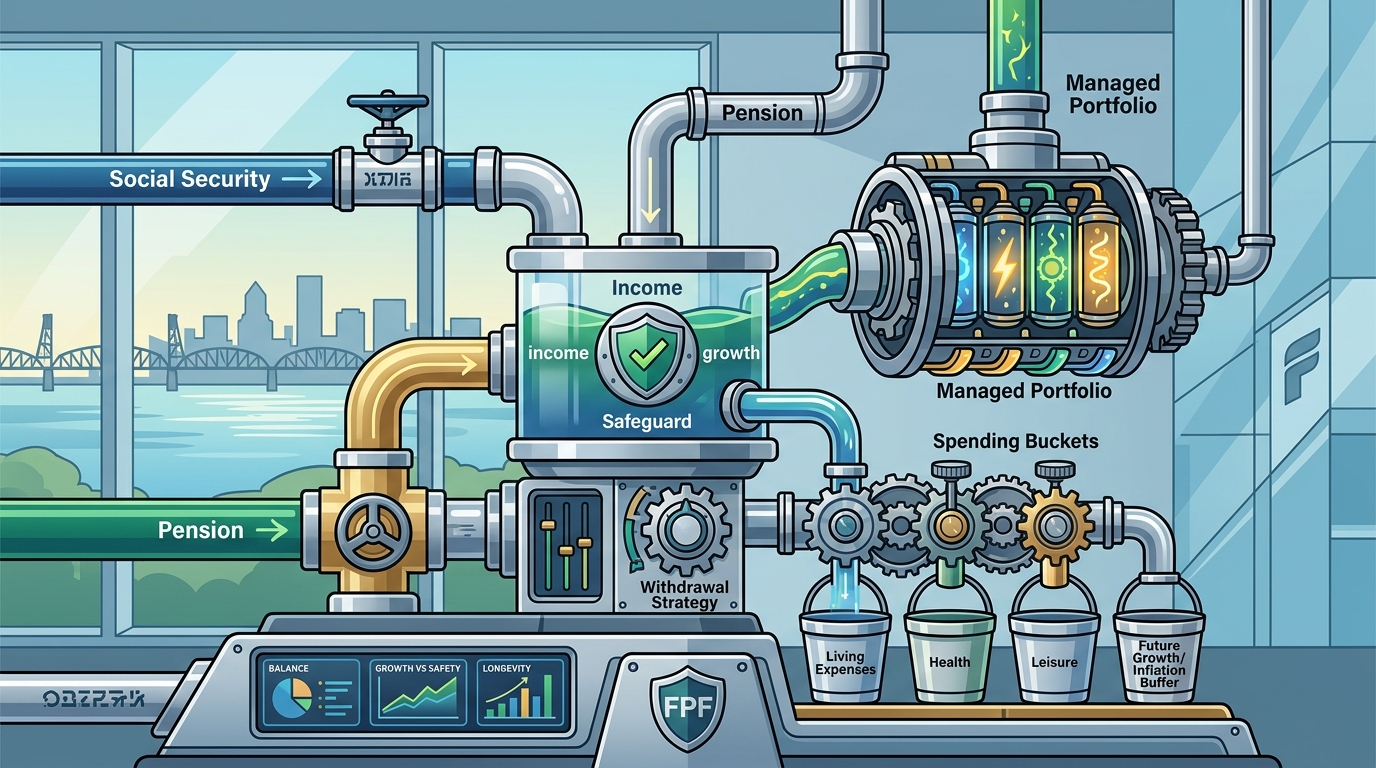
Creating a sustainable retirement income stream requires balancing guaranteed safety with growth potential to outlive your savings. First Pacific Financial helps clients in Vancouver, WA, design personalized withdrawal strategies that protect purchasing power. By combining Social Security, pensions, and managed portfolio distributions, you can ensure financial stability throughout your retirement years. For additional details, review the fp financial com.
The Foundation of Retirement Income Planning
Retirement income planning is the process of determining how to fund your lifestyle after you stop working. It involves calculating your essential expenses and discretionary spending to establish a target monthly income. This baseline dictates how much you need to save and how you should structure your asset allocation. For additional details, review the Customer Experience.
Many retirees fail because they rely solely on a single source of income. A diversified approach spreads risk across different asset classes. For example, a client might allocate 40% of their income needs to Social Security, 30% to a managed portfolio, and 30% to a pension or annuity. This mix provides a stable floor while allowing for growth. For additional details, review the Frequently Asked Questions.
Optimizing Social Security Benefits
Social Security is often the largest source of guaranteed income for American retirees. The timing of your claim significantly impacts your lifetime benefits. Claiming at age 62 results in a lower monthly payment, while waiting until age 70 maximizes your benefit amount. For additional details, review the About.
Consider the case of a dual-income household. The spouse with the higher earnings record should generally delay their claim to maximize the survivor benefit. This strategy ensures that the surviving spouse receives a higher income, which is critical for long-term sustainability. First Pacific Financial analyzes these scenarios to help you make informed decisions about claim timing.
Understanding the break-even point is also essential. If you expect to live past age 80, delaying your claim is usually the mathematically superior choice. This decision should align with your health history and family longevity patterns.
Managing Portfolio Withdrawals Safely
Portfolio withdrawal strategy is the method used to draw down investment assets without depleting them prematurely. The traditional 4% rule suggests withdrawing 4% of your portfolio in the first year of retirement, adjusted for inflation. However, this static approach may not account for market volatility.
Dynamic withdrawal strategies adjust your spending based on market conditions. If the market drops significantly, you reduce your withdrawals to preserve capital. This flexibility can extend the life of your portfolio. For instance, a 2022 market correction required many retirees to adjust their spending plans to avoid drawing down their principal too quickly.
Integrating Tax-Efficient Income Sources
Tax-efficient income planning is the practice of structuring your withdrawals to minimize your tax liability. Different account types, such as Traditional IRAs, Roth IRAs, and taxable accounts, have distinct tax implications. Withdrawing from the wrong account at the wrong time can erode your net income.
For example, withdrawing from a Traditional IRA in a low-income year can keep you in a lower tax bracket. Conversely, using Roth IRA distributions in higher-income years can provide tax-free income. This sequencing strategy can save thousands of dollars over your retirement. First Pacific Financial integrates tax strategy into your income plan to maximize your after-tax dollars.
Required Minimum Distributions (RMDs) also play a role in this planning. Starting at age 73, you must begin taking distributions from Traditional IRAs. Planning for these mandatory withdrawals ensures you do not face unexpected tax bills. Proper sequencing allows you to manage these distributions strategically.
Protecting Against Longevity Risk
Longevity risk is the possibility of outliving your financial resources. This is a primary concern for retirees who live into their 90s or beyond. To mitigate this risk, many individuals consider converting a portion of their portfolio into an annuity.
An annuity is a financial product that provides a guaranteed stream of income for life. By purchasing a single-premium immediate annuity, you can create a baseline income that cannot be depleted. This guaranteed floor allows you to take more risk with the remainder of your portfolio. For example, securing 60% of your income needs with an annuity allows you to invest the other 40% in growth-oriented assets.
First Pacific Financial evaluates whether an annuity fits your overall financial picture. We consider your health, family history, and other income sources before recommending this strategy. This ensures that your income stream remains sustainable regardless of how long you live.
Key Takeaways
- Diversify your income sources to reduce reliance on any single asset class.
- Optimize Social Security claim timing to maximize lifetime benefits and survivor protection.
- Use dynamic withdrawal strategies to adjust spending based on market conditions.
- Sequence withdrawals from tax-advantaged accounts to minimize your tax liability.
- Consider annuities to mitigate longevity risk and create a guaranteed income floor.
- Regularly review and adjust your income plan with a fiduciary advisor.
Frequently Asked Questions
What is the safest way to generate retirement income?
The safest approach combines guaranteed income sources like Social Security and annuities with a managed portfolio. This mix provides a stable baseline while allowing for growth and inflation protection.
How much should I withdraw from my portfolio each year?
There is no one-size-fits-all answer. A common starting point is 4%, but dynamic strategies that adjust for market conditions are often safer. Your specific withdrawal rate should be determined by a financial advisor based on your overall financial picture.
When should I claim Social Security?
The optimal claim age depends on your individual circumstances, including health, family history, and other income sources. Waiting until age 70 maximizes your monthly benefit, but claiming earlier may be appropriate if you have limited other income.
What is an annuity and how does it help with retirement income?
An annuity is a contract with an insurance company that provides a guaranteed stream of income. It helps mitigate longevity risk by ensuring you have a baseline income that cannot be depleted, regardless of how long you live.
How do taxes affect my retirement income?
Taxes can significantly reduce your net income. By sequencing withdrawals from different account types, such as Traditional IRAs, Roth IRAs, and taxable accounts, you can minimize your tax liability and maximize your after-tax income.
Why is it important to work with a fiduciary advisor?
A fiduciary advisor is legally obligated to act in your best interest. This ensures that the advice you receive is unbiased and focused on your specific financial goals, rather than on selling products that generate commissions for the advisor.
How often should I review my retirement income plan?
You should review your plan at least annually, or whenever there is a significant change in your financial situation, such as a market correction, a change in health, or a shift in your spending needs.
Conclusion
Creating a sustainable retirement income stream is a critical component of a successful retirement. By diversifying your income sources, optimizing Social Security, managing portfolio withdrawals, and protecting against longevity risk, you can ensure financial stability throughout your retirement years. First Pacific Financial provides fee-only, fiduciary advice to help you navigate these complex decisions. Our team in Vancouver, WA, is dedicated to helping you achieve your financial goals with personalized, values-based planning. today to start building your sustainable retirement income plan.