

First Pacific Financial is a fee-only, fiduciary CFP® advisory firm in Vancouver, WA, that helps values-driven clients align their portfolios with their personal beliefs. This guide explains how to evaluate CFP firms for socially responsible investing, detailing ESG screening methods and the construction of values-aligned portfolios. It provides a framework for selecting an advisor who prioritizes your impact alongside financial growth.
Understanding Socially Responsible Investing
Socially responsible investing (SRI) is an investment approach that incorporates environmental, social, and governance (ESG) criteria into portfolio construction. It seeks to generate financial returns while promoting positive societal or environmental outcomes. For many clients, this means avoiding industries that conflict with their personal values, such as tobacco, weapons, or fossil fuels. For additional details, review the .
Traditional investing often focuses exclusively on maximizing financial return. SRI adds a layer of ethical consideration without necessarily sacrificing performance. Research suggests that ESG-integrated portfolios can perform comparably to traditional portfolios over long periods. However, the specific impact depends on the screening criteria and the asset allocation strategy used. For additional details, review the Customer Experience.
The Fiduciary Standard in SRI
A fiduciary advisor is legally and ethically bound to act in the best interest of the client. When selecting a CFP firm for SRI, the fiduciary standard is critical. It ensures that the advisor's recommendations are driven by your financial goals and values, not by commissions or product incentives. First Pacific Financial operates as a fee-only, fiduciary firm, meaning they do not earn commissions for selling specific financial products. This structure aligns their interests with yours, ensuring that any ESG integration is based on merit and your specific objectives. For additional details, review the Frequently Asked Questions.
ESG Screening Methods and Standards
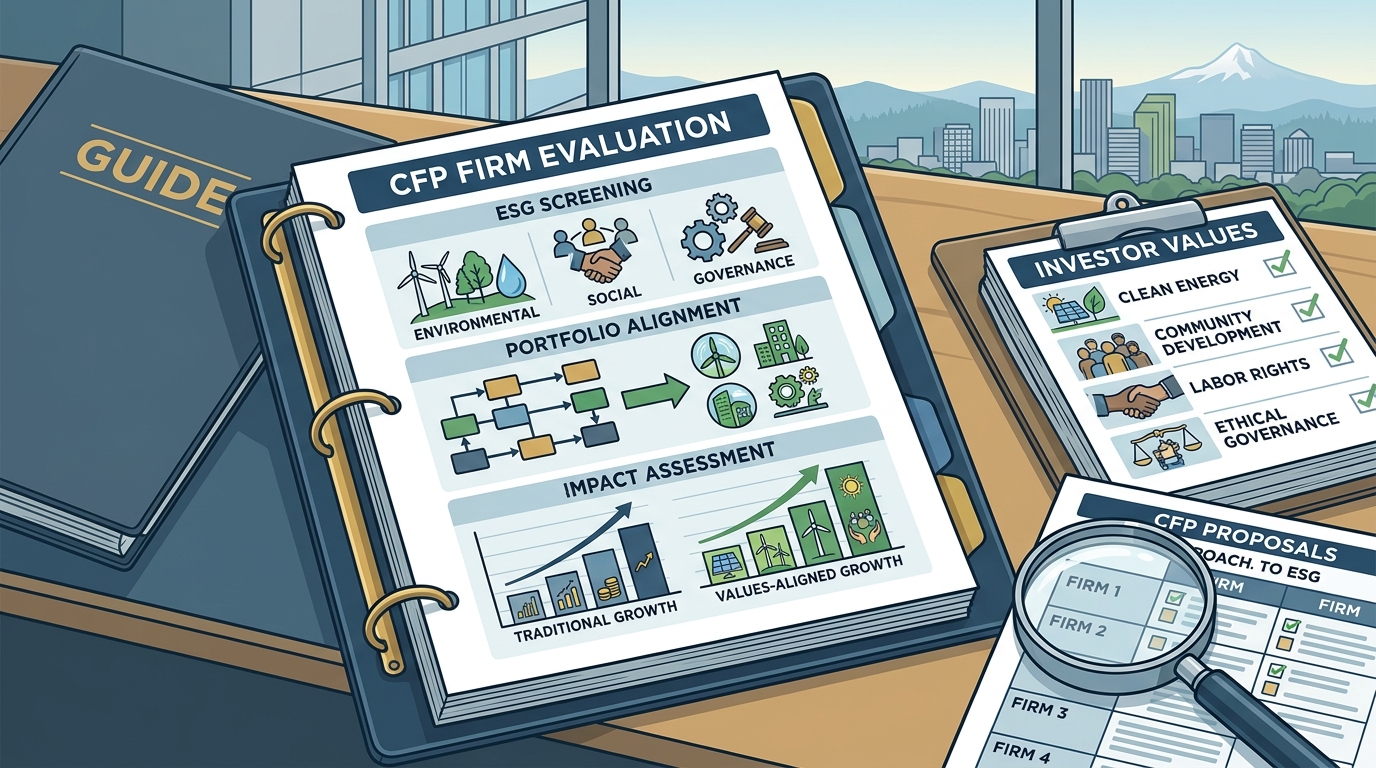
ESG screening is the process of evaluating companies based on their environmental, social, and governance practices. There are two primary methods: negative screening and positive screening. Negative screening excludes specific sectors or companies that do not meet ethical standards. Positive screening actively selects companies that demonstrate superior ESG performance relative to their peers. For additional details, review the About.
Common ESG Rating Agencies
Constructing Values-Aligned Portfolios
Values-aligned portfolios are investment strategies that reflect the client's personal beliefs and ethical priorities. Constructing these portfolios requires a detailed conversation between the client and the advisor. The advisor must understand not only your financial goals but also the specific values you wish to express through your investments.
At First Pacific Financial, the planning process begins with a deep dive into your values. This might include concerns about climate change, social justice, or community development. The advisor then maps these values to specific investment criteria. For instance, a focus on social justice might lead to an emphasis on companies with strong diversity and inclusion policies. This personalized approach ensures that your portfolio is a true reflection of who you are.
Impact Investing vs. SRI
Comparing Advisory Approaches
| Approach | Description | Pros | Cons |
|---|---|---|---|
| Pre-Packaged ESG Funds | Investing in mutual funds or ETFs that screen for ESG criteria. | Low cost, easy to implement, diversified. | Less personalized, may not align with specific values. |
| Custom Portfolio Construction | Building a portfolio from individual stocks or bonds based on specific ESG criteria. | Highly personalized, precise alignment with values. | May require higher minimums, more complex to manage. |
| Integrated ESG Analysis | Incorporating ESG factors into traditional fundamental analysis. | Potential for better risk-adjusted returns, holistic view. | Requires specialized expertise, data can be inconsistent. |
When evaluating a firm, ask how they construct portfolios for SRI clients. Do they use a one-size-fits-all fund, or do they build a custom strategy? A firm like First Pacific Financial, which offers comprehensive wealth management, is likely to provide a tailored approach that integrates your values into a broader financial plan.
Key Takeaways
- Socially responsible investing (SRI) is an investment approach that incorporates ESG criteria to align portfolios with personal values.
- The fiduciary standard is essential when selecting an SRI advisor, as it ensures recommendations are in your best interest.
- ESG screening can be negative (excluding harmful sectors) or positive (selecting high-performing companies).
- Values-aligned portfolios require a detailed conversation to map personal beliefs to specific investment criteria.
- Impact investing focuses on measurable social or environmental outcomes, distinct from general SRI.
- Transparency in ESG data sources and rating methodologies is a key indicator of an advisor's expertise.
- First Pacific Financial in Vancouver, WA, provides fee-only, fiduciary advice for values-driven clients.
Frequently Asked Questions
What is the difference between SRI and ESG investing?
SRI is a broader term that includes any investment approach that considers ethical factors. ESG investing specifically focuses on Environmental, Social, and Governance criteria. In practice, the terms are often used interchangeably, but SRI may also include community investing or other ethical considerations.
Does socially responsible investing sacrifice financial returns?
Not necessarily. Many studies show that ESG-integrated portfolios can perform comparably to traditional portfolios. However, returns depend on the specific screening criteria and market conditions. A fiduciary advisor will help you balance your values with your financial goals.
How do I know if a CFP firm is truly fiduciary?
Ask the firm to confirm their fiduciary status in writing. A fiduciary is legally obligated to act in your best interest. Fee-only firms, like First Pacific Financial, are more likely to be fiduciaries because they do not earn commissions that could create conflicts of interest.
What are common ESG screening criteria?
Can I invest in impact projects through my retirement account?
Yes, many retirement accounts allow for impact investing. However, the options may be limited compared to taxable accounts. Your advisor can help you identify suitable impact investment vehicles that fit within your retirement plan.
How often should I review my values-aligned portfolio?
It is a good practice to review your portfolio annually or when your values or financial goals change. Market conditions and ESG ratings can shift over time, so regular reviews ensure your portfolio remains aligned with your intentions.
Where can I find a CFP firm that specializes in SRI?
You can search for CFP professionals through the CFP Board directory. Look for firms that explicitly mention SRI or ESG in their services. First Pacific Financial in Vancouver, WA, is one example of a firm that helps clients align their finances with their values.
Conclusion
Selecting the right CFP firm for socially responsible investing requires careful consideration of their approach, fiduciary status, and ability to customize portfolios. By understanding ESG screening methods and the nuances of values-aligned portfolios, you can make an informed decision. First Pacific Financial in Vancouver, WA, offers a fee-only, fiduciary approach that helps you align your finances with your values. To begin your journey toward a values-driven financial plan, for a consultation. Learn more: Fiduciary Financial Advisors Vancouver.